

Use menthol when you want fast, cooling relief for acute soreness. Use capsaicin when you're managing chronic pain or stubborn itch and can tolerate a burning startup phase. That's the whole decision tree in one sentence, but the reasons behind it matter.
Before you reach for either one, run through this:
- Patch test a small area first and wait at least an hour before applying more, especially with capsaicin.
- Never apply either ingredient to broken skin, recent burns, or near your eyes and mucous membranes.
- Expect a transient burning sensation with capsaicin. That's the mechanism working, not a sign something went wrong.
The split between "cooling" and "burning" isn't marketing. It traces back to two different receptors, TRPM8 and TRPV1, and a growing stack of human studies and clinical reviews, including guidance from the Cleveland Clinic, back up how each one actually performs.
Key Takeaways
Menthol delivers fast, perceptual pain relief through TRPM8 cooling, while capsaicin builds longer-term relief for chronic pain and itch through TRPV1 desensitization, and combining them can cancel out menthol's benefit.
| Point | Details |
|---|---|
| Menthol wins for speed | TRPM8 activation gives immediate cooling and lowers perceived pain within minutes. |
| Capsaicin wins for chronic conditions | TRPV1 desensitization builds over repeated use, helping itch and persistent pain. |
| Avoid mixing them | A 2023 trial found menthol plus capsaicin erased menthol's standalone pain-relief benefit. |
| Contraindications are strict | Skip broken skin, eyes, and mucous membranes with either ingredient. |
| Formulated balms offer both paths | Mongoosecbd's balms use menthol or cayenne pepper alongside CBD depending on the formulation. |
Table of Contents
- Menthol vs Capsaicin: How Each One Talks to Your Nerves
- What the Research Actually Shows About Pain and Itch Relief
- Safety Rules Before You Apply Either One
- How to Apply Menthol or Capsaicin the Right Way
- Where a CBD Balm Fits Into This Comparison
- Ready to Try a Balm Built for Real Relief?
- The Real Lesson Buried in the Research
- Frequently Asked Questions
- Sources
Menthol vs Capsaicin: How Each One Talks to Your Nerves
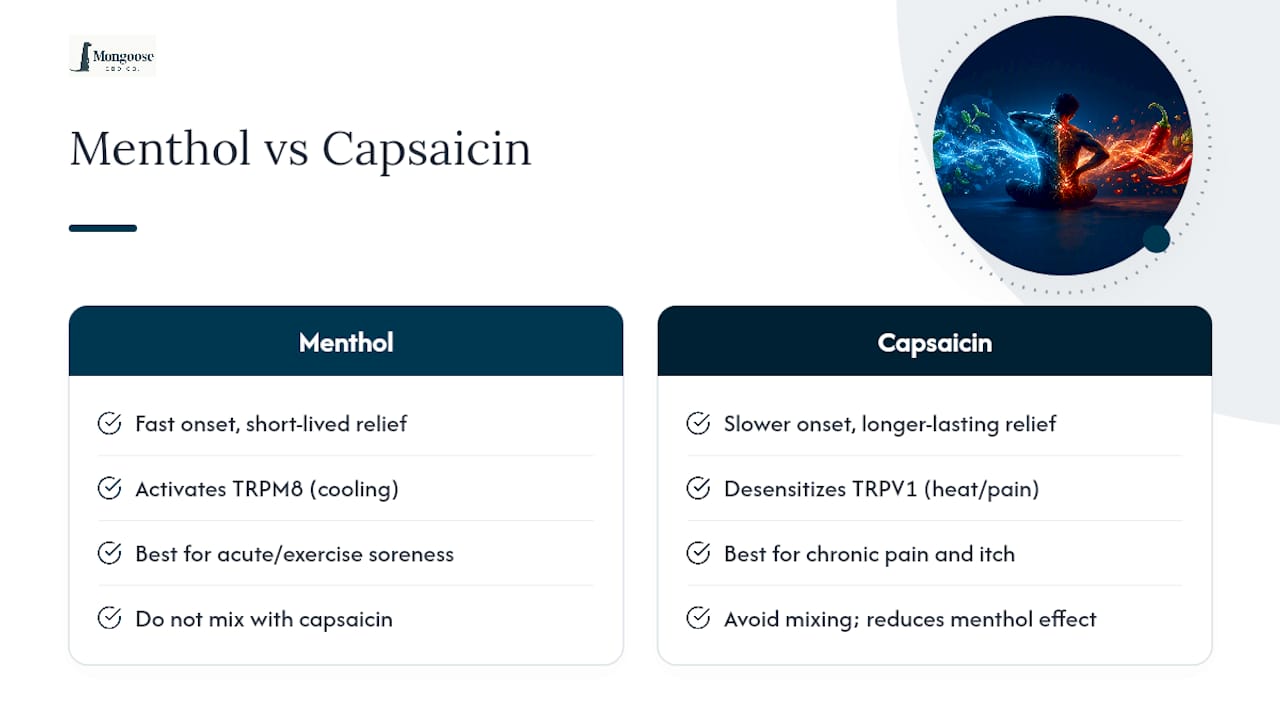
Menthol and capsaicin don't work through the same door. Menthol binds to TRPM8, a receptor on sensory nerve endings that normally responds to cold. Flip that switch and your brain registers "cool," even though the skin temperature hasn't dropped at all. It's a sensory illusion, but a useful one: that cooling signal competes with pain signals traveling the same nerve pathways, which is part of why menthol can make sore muscles feel better within minutes.
Capsaicin takes the opposite route. It binds TRPV1, the receptor responsible for detecting heat and chemical irritants (it's the same receptor that makes chili peppers burn your mouth). The first application often stings or burns because you're flooding that receptor. But repeated exposure leads to something more useful than a fleeting sensation: functional desensitization. The nerve fibers carrying pain signals become less responsive over time, which is the actual mechanism behind capsaicin's longer-term benefit for chronic pain and itch.
Here's where it gets complicated. TRPM8 and TRPV1 receptors sit close together on the same sensory neurons in many cases, and they don't operate in isolation. When you apply menthol and capsaicin together, the cooling signal from TRPM8 doesn't just add to the burning signal from TRPV1. It can interfere with it.
- Menthol alone: fast cooling sensation, reduced perceived pain, no change in actual tissue temperature.
- Capsaicin alone: initial burn, followed by gradual desensitization with repeated use.
- Menthol plus capsaicin: mixed signaling that can cancel out menthol's perceptual advantage entirely.
Pro Tip: If you've ever noticed a "cooling" muscle rub feels less impressive after a few days, it's not your imagination. Menthol's benefit is partly a distraction effect on your nervous system, not a lasting change in tissue, so the sensation fades faster than a capsaicin regimen built for desensitization.
What the Research Actually Shows About Pain and Itch Relief
The clinical evidence for menthol and capsaicin isn't identical in scope, and it doesn't point to the same conclusions for every condition.
Start with itch. A review on capsaicin and menthol receptor pharmacology documented that topical capsaicin relieved idiopathic pruritus ani, a stubborn form of anal itching, in cases where menthol (used as the placebo comparison) did not. Both produced some transient burning on application, but only capsaicin delivered lasting relief. That result lines up with the desensitization mechanism: itch-signaling fibers respond to the same TRPV1 pathway that carries certain pain signals, so knocking down their responsiveness helps itch the same way it helps some forms of chronic pain.
Now look at acute exercise-related soreness. A 2023 randomized trial tested isolated menthol against a menthol and capsaicin combination during exercise in the heat. Isolated menthol reduced both perceived pain and rate of perceived exertion compared to placebo. But when researchers combined it with capsaicin, that advantage disappeared. The co-application didn't add benefit. It erased one.

That single finding has real practical weight: pairing these two ingredients isn't automatically "double the relief." Sometimes it's less than either ingredient alone.
Broader clinical guidance from the Cleveland Clinic confirms both agents have a role in minor muscle and joint pain, including osteoarthritis, but the onset and tolerability differ. Menthol works within minutes and fades relatively quickly. Capsaicin needs repeated, consistent application, often over days to weeks, before its desensitizing effect builds to something noticeable.
Menthol's reputation extends beyond pain relief into inflammation, though the evidence here is thinner. Preclinical models suggest menthol has some anti-inflammatory activity, but that data comes mostly from lab and animal studies. Robust human evidence for menthol as an anti-inflammatory agent, rather than a sensory analgesic, still isn't established.
| Condition | Better evidence for | Why |
|---|---|---|
| Chronic itch (pruritus) | Capsaicin | Desensitizes TRPV1 fibers carrying itch signals |
| Acute exercise soreness | Menthol | Fast TRPM8-driven cooling, lowers perceived exertion |
| Osteoarthritis/joint pain | Both, differently | Menthol for quick comfort, capsaicin for sustained modulation |
| Combined application | Neither, reliably | Co-application can cancel menthol's specific benefit |
Safety Rules Before You Apply Either One
Both ingredients are generally well tolerated on intact skin, but the margin for error shrinks fast once skin integrity or sensitive tissue is involved.
- Never apply menthol or capsaicin to broken skin, open wounds, recent sunburn, or any area with a rash or dermatitis.
- Keep both away from eyes, nose, mouth, and genital mucous membranes. Capsaicin especially can cause intense, prolonged stinging on contact with sensitive membranes.
- Wash your hands thoroughly after application, before touching your face or anyone else.
- If you're pregnant, treating a child, or managing a chronic skin condition like eczema or psoriasis, check with a clinician before starting either ingredient regularly.
- If you get capsaicin or menthol in your eyes, flush immediately with cool water for several minutes and seek medical care if burning or vision changes persist.
Expect some burning with capsaicin. That's the desensitization process starting, and it typically fades with repeated use. Expect mild tingling or occasional skin irritation with menthol, particularly at higher concentrations or on sensitive skin.
Pro Tip: Keep a small notecard by your topical products listing the exact application time. Capsaicin's benefit builds with consistency, and it's easy to lose track of whether you applied it this morning or forgot entirely.
How to Apply Menthol or Capsaicin the Right Way
Formulation matters as much as ingredient choice. Gels and creams absorb fast and deliver quicker onset, which suits acute soreness where you want relief in minutes. Patches release their active ingredient more slowly over hours, which fits a steadier, all-day dosing pattern. Lotions tend to carry lower concentrations and work well for people with sensitive skin who still want some sensory relief.
Over-the-counter menthol products commonly vary widely in concentration, and capsaicin products for minor aches are available in lower concentrations, with stronger formulations used under clinical supervision. Higher capsaicin concentrations mean a more intense initial burn and usually require gradual up-titration rather than jumping straight to the strongest option, according to Cleveland Clinic guidance.
- Start with a small test patch of skin and wait at least an hour before judging your reaction.
- Apply a thin layer rather than a thick one. More product doesn't mean faster relief, and it raises irritation risk.
- Give capsaicin time. A single application won't tell you much. Plan on consistent use over several days to a couple of weeks before deciding it isn't working.
- Reserve menthol for acute, situational soreness like a hard workout or a stiff neck, where quick perceptual relief is the goal.
If capsaicin isn't working after a reasonable trial, or the burning is too much to tolerate consistently, pause rather than push through discomfort. Some people rotate strategies: menthol immediately after activity for fast comfort, capsaicin as a separate nightly routine for chronic joint or nerve pain, applied at different times rather than combined. That sequencing avoids the interference effect documented in exercise research without giving up either ingredient's strengths. For more on capsaicin-specific formulations and how they're used in recovery routines, see this breakdown of capsaicin balm benefits.
| Point | Details |
|---|---|
| Match ingredient to problem | Menthol suits acute soreness; capsaicin suits chronic pain and stubborn itch. |
| Don't combine them | Co-application can cancel menthol's perceptual pain relief, per 2023 exercise research. |
| Expect a burn with capsaicin | Initial stinging is normal and linked to the desensitization process, not injury. |
| Give capsaicin time | Benefits build over repeated use, not a single application. |
| Protect broken skin and eyes | Both ingredients are unsafe on wounds, rashes, or near mucous membranes. |
Where a CBD Balm Fits Into This Comparison
If you're already using menthol or capsaicin topically, you don't have to choose between that sensory relief and other ingredients that support recovery. Mongoosecbd formulates balms that pair botanicals like menthol, eucalyptus, and cayenne pepper with 1,000mg of CBD per ounce, built for athletes and people managing chronic soreness or arthritis.
- The Eucalyptus Mint Seriously Soothing Pain Balm leans on a menthol-forward cooling profile for fast, situational relief.
- Formulations that include cayenne pepper bring a capsaicin-like warming sensation to the CBD base, suited to people managing more persistent discomfort.
- All balms are vegan, THC-free, and backed by a 30-day refund policy, so trying one to see what fits your skin and your pain pattern carries little downside.
If you're an athlete chasing quick post-workout comfort, or dealing with the kind of ache that shows up every day, a formulated balm gives you sensory relief and CBD's proposed calming effects in one application, rather than layering separate products.
Ready to Try a Balm Built for Real Relief?
Reading about receptors is useful. Applying something that actually works on your sore shoulder or aching knee is the point. Mongoosecbd's Seriously Soothing Pain Balm line gives you a menthol-forward option for that fast cooling effect the research supports, formulated alongside CBD rather than as an isolated ingredient. For athletes managing recovery after hard training, the Rikki Tikki Recovery balm is built around muscle recovery specifically. Every purchase comes with a 30-day refund window, so testing which formulation matches your pain pattern doesn't require a leap of faith.
The Real Lesson Buried in the Research
The conventional wisdom treats menthol and capsaicin like interchangeable "hot or cold" options you pick based on personal preference. The research says otherwise. These ingredients work through different receptors for different purposes, and stacking them doesn't stack their benefits. That 2023 finding, where co-application erased menthol's advantage, should change how people shop for topical pain relief. Most shoppers assume more active ingredients means more relief. Sometimes it means less.
What actually matters is matching mechanism to problem: capsaicin's slow desensitization for something chronic, menthol's quick perceptual jolt for something acute. Skip the products promising both in one application unless you're prepared for a compromise on either front. Start simple, be patient with capsaicin, and don't assume burning means it's failing.
Frequently Asked Questions
Is menthol effective for chronic pain, or only short-term soreness? Menthol's strength is speed, not duration. It reduces perceived pain within minutes through TRPM8 activation, but the effect fades faster than capsaicin's longer-building desensitization, so it's better suited to acute or exercise-related soreness than long-term chronic pain management.
Can I use menthol and capsaicin together for stronger relief? Generally, no. A 2023 randomized trial found that combining menthol with capsaicin eliminated menthol's standalone pain-relief benefit rather than enhancing it. Using them at separate times, rather than mixed together, avoids that interference.
How does menthol compare to eucalyptus for pain relief? Menthol and eucalyptus are often paired in topical products because both produce a cooling sensation, but menthol acts directly on TRPM8 receptors while eucalyptus oil's cooling effect is generally milder and less receptor-specific. Many formulations, including some Mongoosecbd balms, combine the two for a fuller sensory profile.
What are the main capsaicin health benefits beyond pain relief? Beyond musculoskeletal pain, capsaicin has documented use for pruritus (itch) relief, particularly in cases resistant to other treatments. Its mechanism, desensitizing TRPV1-bearing nerve fibers, applies to both itch and certain chronic pain conditions.
Does cayenne pepper work the same way as pharmaceutical-grade capsaicin? Cayenne pepper contains capsaicin naturally, and topical products using cayenne extract work through the same TRPV1 mechanism. Concentration and purity vary by formulation, which affects intensity and how quickly desensitization builds.
Is it safe to use these products every day? Menthol is generally fine for regular use on intact skin. Capsaicin actually depends on consistent, repeated application to build its desensitizing effect, so daily use over one or two weeks is often part of the intended regimen. Watch for excessive irritation and stop if skin breaks down.
This article is general information, not a substitute for advice from a qualified doctor. Consult a qualified healthcare professional about your own circumstances before acting on anything here.
Sources
- Capsaicin and menthol in the treatment of itch and pain: recently cloned receptors provide the key
- Topical application of isolated menthol and combined menthol‐capsaicin creams: Exercise tolerance, thermal perception, pain, attentional focus and thermoregulation in the heat
- Capsaicin; Menthol (capsaicin/menthol patches) — Cleveland Clinic