
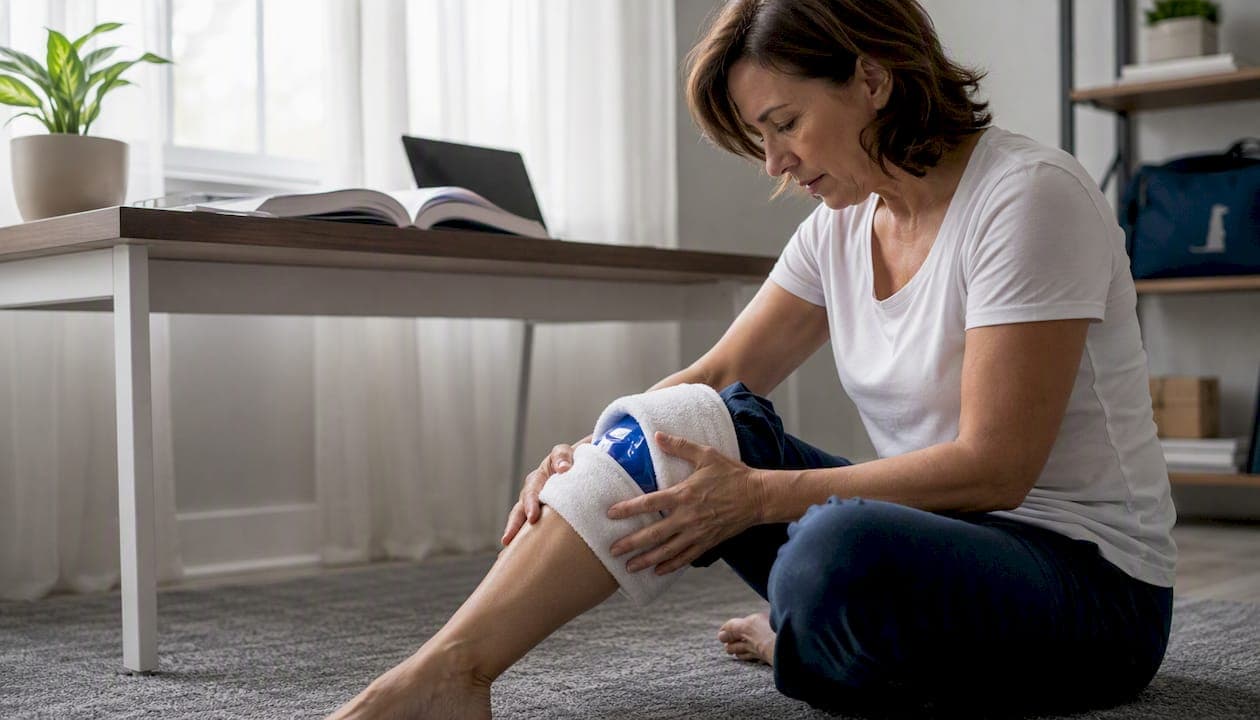
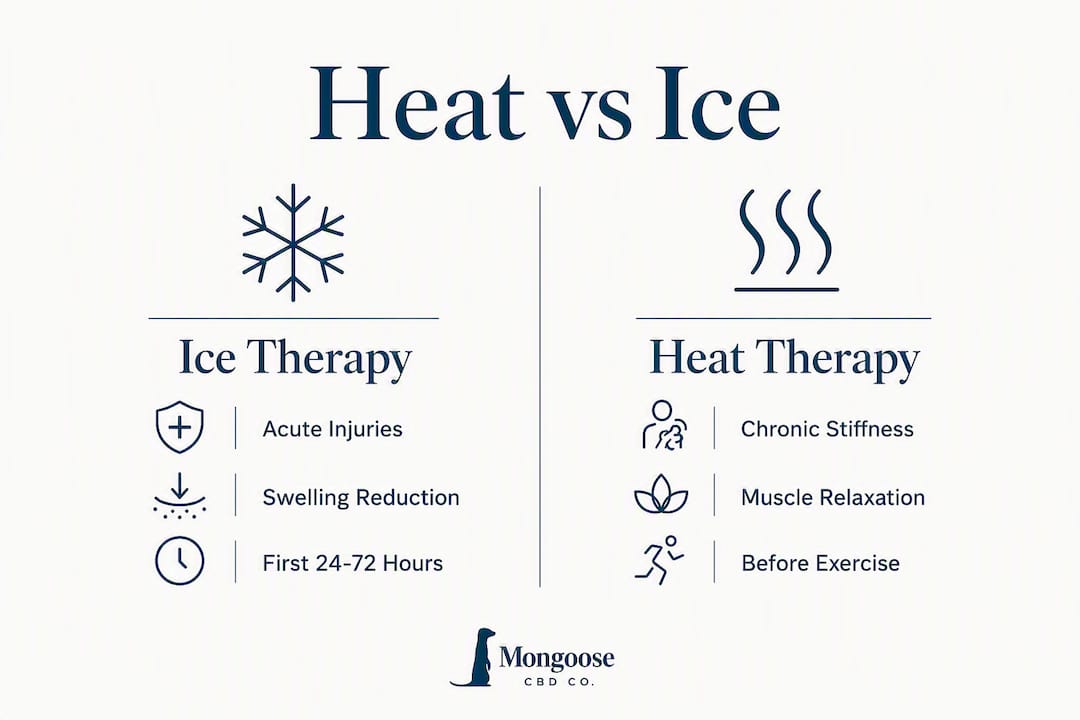
Use ice for new injuries with swelling during the first 24–72 hours. Use heat for chronic stiffness, tight muscles, or soreness that lingers after the swelling is gone. That single rule covers the majority of everyday muscle decisions.
Why does it work that way? Cold causes vasoconstriction, which slows blood flow to the injured area, reduces swelling, and numbs sharp pain. Heat does the opposite: vasodilation increases circulation, loosens stiff tissue, and improves range of motion. Applying heat to a fresh, swollen injury drives more fluid into already-inflamed tissue. Applying ice to a chronically stiff muscle makes it tighter.
Quick application rule:
- Ice: short sessions per application, repeated several times per day, always with a cloth barrier between the pack and your skin
- Heat: short sessions per application, with temperature kept safely moderate for superficial application, never applied to actively swollen tissue
- Topical balms (such as Mongoosecbd's Rikki Tikki Recovery) can complement either approach for day-to-day soreness management
Both the Hospital for Special Surgery (HSS) and Lehigh Valley Health Network (LVHN) anchor their guidance to these same timing and temperature principles.
Pro Tip: When you're unsure whether swelling is present, press gently around the sore area. Puffiness, warmth to the touch, or visible bruising means ice. No swelling, just stiffness or dull aching? Heat.
Table of Contents
- When should you use ice for muscle pain?
- When does heat therapy work better than ice?
- How should you use heat and ice around exercise?
- How do you apply heat and ice safely?
- When is heat or ice not enough — and you need a clinician?
- Can topical balms complement heat and ice therapy?
- Key Takeaways
- The part most people get backwards
- Mongoosecbd balms for daily muscle maintenance
- Authoritative sources and further reading
When should you use ice for muscle pain?
Cold therapy is the standard first response to acute injury. An acute injury is one that happened recently — for example, a sprained ankle from a recent run, a muscle pull from a recent game, or any area that is visibly swollen, warm, or bruised within the first few days after injury.
What cold actually does to tissue:
Vasoconstriction reduces local blood flow, which limits the amount of inflammatory fluid that pools around the injury. Numbing occurs because cold slows nerve conduction velocity, which is why a bag of ice on a fresh sprain can cut sharp pain within minutes. According to HSS, cold therapy applied during the first 24–72 hours is the correct choice for new injuries with swelling, and sessions should run 15–20 minutes with repetition up to 3 times per day. The Cleveland Clinic reinforces this: start with cold for acute injury, then switch to heat once inflammation has subsided.
When ice is the right call:
- New swelling, bruising, or warmth at the injury site
- Sharp pain that started within the last 24–72 hours after physical trauma or overload
- Post-exercise inflammation when a joint or muscle feels hot and puffy
- Headaches with a throbbing quality that respond to cold
When to avoid ice:
- Poor circulation or peripheral vascular disease
- Peripheral neuropathy or diabetes (reduced sensation increases burn risk)
- Open wounds or broken skin
- Cold intolerance or Raynaud's phenomenon
LVHN's guidance is direct: always use a cloth barrier, check the skin every few minutes, and never leave ice in place beyond 20 minutes to avoid frostbite.
Pro Tip: A gel pack wrapped in a thin towel conforms better to a curved joint (knee, ankle, shoulder) than a rigid ice bag. Pair it with gentle elevation when the injury is on a limb — gravity helps drain excess fluid.
When does heat therapy work better than ice?
Heat is the right choice for pain that is not driven by active inflammation. Chronic muscle tightness, recurring joint stiffness, old injuries that have healed but still ache, and morning stiffness from conditions like arthritis all respond better to warmth than to cold.
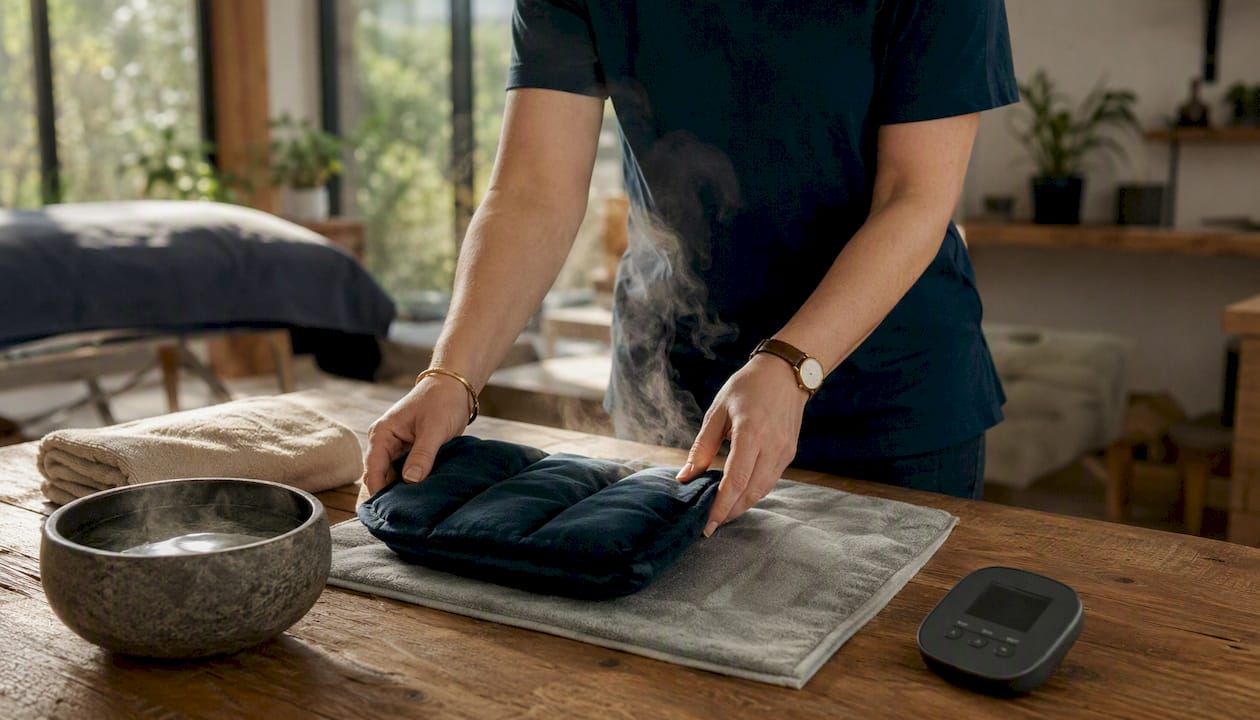
The physiological case is clear. An international multidisciplinary Delphi consensus published in Pain and Therapy (Springer Nature) found that superficial heat therapy produces measurable increases in local blood flow and tissue metabolism, improves muscle extensibility, and delivers short-term analgesia in chronic musculoskeletal pain when used as part of a multimodal approach. Vasodilation brings oxygen and nutrients to stiff tissue, which is why a warm compress on a chronically tight neck feels immediately better than an ice pack would.
Common situations where heat helps:
- Chronic muscle tightness or recurring back stiffness (longer than roughly 4 weeks)
- Morning joint stiffness from arthritis or overuse
- Muscle spasm without active swelling
- Pre-activity warm-up when you want to increase tissue extensibility before exercise
The Arthritis Foundation specifically recommends warm baths or compresses for reducing morning stiffness and improving range of motion in chronic conditions. Moist heat — a warm bath, a damp hot pack, or a moist heating pad — penetrates tissue more effectively than dry heat, according to Harvard Health. Dry heat from a standard electric heating pad still works; it just tends to dehydrate surface tissue faster.
Types of heat to use:
- Moist heat: warm baths, hydrocollator packs, damp towel heated briefly
- Dry heat: electric heating pads, heat wraps (such as disposable air-activated patches)
- Infrared or paraffin wax: useful for hands and small joints, typically in clinical settings
Critical safety limits: Never apply heat to actively swollen or bruised tissue. Keep superficial heat below 113°F. People with neuropathy or reduced skin sensation should check with a clinician before using any heat source at home, since they cannot reliably detect when tissue is being damaged.
How should you use heat and ice around exercise?
The timing question for athletes comes up constantly: heat before, ice after, or the reverse?

The short answer: heat before exercise, ice after — when symptoms call for it. Applying ice before a workout stiffens muscles and reduces performance. A warm compress or a moist heat pack applied for 10–15 minutes before activity increases tissue extensibility and helps prime the muscle for movement. Pair that with a dynamic warm-up and you have a solid pre-workout routine.
Post-exercise is where the evidence gets more nuanced. Carrell Clinic's review notes that some studies show heat reduces muscle damage when applied immediately after exercise, while others show cold is superior at the 24-hour mark for pain perception. The honest answer is that the evidence is mixed, and timing matters more than a rigid rule.
Practical framework for the 72-hour recovery window:
- Immediately post-exercise with visible swelling or joint heat: use ice for 15–20 minutes
- No swelling, just general fatigue: either modality is reasonable; many athletes prefer cold for the first 24 hours
- 24–72 hours out (DOMS territory): experiment with heat for persistent stiffness once acute inflammation has settled
- Pre-next-workout: heat or active warm-up to restore range of motion
Delayed onset muscle soreness (DOMS) typically peaks around 24–48 hours after unfamiliar or high-intensity exercise. Cold within the first 24 hours can blunt the worst of the pain. After that, switching to heat often helps more because the acute inflammatory phase has passed and the dominant issue becomes stiffness and residual tension.
Pro Tip: Keep a reusable gel pack in the freezer and a heat wrap in your gym bag. That way the decision is made before soreness sets in, not after.
How do you apply heat and ice safely?
Getting the therapy right matters less if the application causes a burn or frostbite. These are the steps that prevent the most common mistakes.
Step-by-step for both modalities:
- Prepare the pack: wrap a gel pack or ice bag in a thin cloth towel; for heat, test the pad or pack on your inner wrist before applying to the target area
- Position comfortably: lie or sit so the pack rests against the area with light contact — no pressure needed
- Set a timer: 15–20 minutes maximum per session
- Check the skin at 5 minutes: if you see mottling, excessive redness, or feel burning, remove immediately
- Allow recovery time: let skin return to normal temperature before reapplying
- Repeat up to 3 times per day for ice; similar intervals for heat
| Modality | Session length | Max daily sessions | Temperature limit | Barrier required |
|---|---|---|---|---|
| Ice / cold pack | 15–20 min | 3x/day | Below freezing — use barrier | Yes, always |
| Heat pad / moist heat | 15–20 min | 3–4x/day | Below 113°F (superficial) | Yes, for dry heat pads |
| Contrast therapy | Alternate 10 min each | 2–3 cycles | Same limits apply | Yes |
For contrast (alternating) therapy, Harvard Health recommends waiting at least 1–2 hours between modalities in home settings to avoid sending conflicting vascular signals to the tissue.
Do-not-do list:
- Never apply ice or heat directly to bare skin
- Never sleep with a heating pad on high or leave it unattended
- Never leave ice on indefinitely — 20 minutes is the ceiling
- Never use heat on a fresh, swollen injury
- Never use either modality on open wounds or infected skin
People who are pregnant, have heart conditions, or have poor circulation should consult a clinician before using heat therapy, particularly over the abdomen or chest.
When is heat or ice not enough — and you need a clinician?
Both therapies manage symptoms. They do not diagnose or repair structural damage. Certain signs mean you need professional evaluation, not another ice pack.
Red flags that warrant prompt care:
- Severe or rapidly worsening pain that does not respond to either modality
- Rapidly increasing swelling, especially after trauma
- Visible deformity, inability to bear weight, or suspected fracture
- Fever alongside a swollen, hot joint (possible infection or septic arthritis)
- Numbness, tingling, or loss of function in the affected limb
- Symptoms that do not improve after 3–5 days of appropriate home therapy
For urgent symptoms — suspected fracture, fever with joint swelling, or sudden loss of function — go to an emergency room or urgent care the same day. For symptoms that are worsening but not immediately dangerous, schedule a clinic appointment within a day or two rather than waiting it out.
Pro Tip: People with diabetes, peripheral vascular disease, or neuropathy should lower their threshold for seeking care. Reduced sensation means tissue damage can occur before pain signals it — and infections in these populations escalate faster.
Can topical balms complement heat and ice therapy?
Topical analgesic balms work through a different mechanism than thermal therapy, which is exactly why they can be useful alongside it rather than instead of it.
Where ice and heat work by changing tissue temperature and blood flow, topicals act on local sensory receptors. Menthol activates cold-sensitive TRPM8 receptors, producing a cooling sensation that modulates pain perception without actually lowering tissue temperature. Capsaicin (from cayenne pepper) desensitizes TRPV1 receptors over repeated use, reducing the intensity of pain signals. Arnica has a long history of use for bruising and muscle soreness, and turmeric and eucalyptus contribute anti-inflammatory and analgesic properties at the application site.
Where topicals fit best:
- Ongoing mild-to-moderate muscle soreness when repeated thermal sessions are impractical
- Chronic muscle tension during the workday (a balm at your desk is easier than a heating pad)
- Post-thermal maintenance: applying a balm after an ice or heat session can extend the sensory relief window
- Athletes who want targeted application between training sessions
CBD, the active compound in Mongoosecbd's formulations, is thought to interact with local endocannabinoid receptors involved in pain and inflammation signaling. It does not replace systemic anti-inflammatory medications, and topical CBD does not enter the bloodstream in meaningful amounts. The benefit is localized sensory modulation, which is appropriate for the muscle soreness and chronic tension use cases described above.
How to combine topicals with thermal therapy: Apply the balm after a thermal session, not during. Applying a menthol-heavy product under a heating pad can intensify heat sensation unpredictably. Never apply any topical to broken or irritated skin.
Mongoosecbd's Miracle Muscle Balm combines CBD with menthol, arnica, turmeric, eucalyptus, and peppermint — ingredients that address sensory relief from multiple angles. The Seriously Soothing Pain Balm in Eucalyptus Mint is a good option for people who prefer a cooling sensation similar to what menthol-forward products deliver.
Pro Tip: Apply a topical balm to a chronically stiff area about 10 minutes before a heat session. The initial sensory effect from menthol can help you tolerate the warmth better and may improve the overall relief you get from the session.
Key Takeaways
Ice for new swelling and heat for chronic stiffness is the core rule — apply each for 15–20 minutes with a cloth barrier, up to 3 times per day, and switch modalities only after the acute inflammatory phase has passed.
| Point | Details |
|---|---|
| Ice for acute injury | Use cold therapy during the initial days after injury when swelling, bruising, or sharp pain is present. |
| Heat for chronic stiffness | Switch to heat once swelling has resolved; moist heat penetrates tissue more effectively than dry. |
| Session length and frequency | 15–20 minutes per session, up to 3 times per day; always use a cloth barrier to protect skin. |
| Red flags for clinical care | Seek evaluation for suspected fracture, fever with joint swelling, worsening symptoms, or loss of function. |
| Mongoosecbd as daily complement | Mongoosecbd topical balms with menthol, arnica, and CBD support day-to-day soreness management between thermal sessions. |
The part most people get backwards
Most people reach for ice out of habit, regardless of what is actually happening in the tissue. A stiff lower back on a Monday morning is not an acute injury — it is chronic tension, and ice will make it worse. The decision tree is simpler than it seems: if the area is swollen, warm to the touch, or was injured within the last three days, use cold. If it just aches, feels tight, or has been bothering you for weeks, use heat.
What I find underappreciated is the transition window. The 48–72 hour mark is where most people stay stuck on ice long after the acute phase has passed. Swelling has gone down, but they keep icing because that is what they started with. That is the moment to switch. Heat at that stage restores tissue extensibility, gets circulation moving again, and sets up better outcomes from any stretching or rehab work that follows.
Topical balms occupy a genuinely useful third lane here. They are not a replacement for thermal therapy during an acute injury, and they are not a substitute for medical care when something is seriously wrong. But for the daily grind of chronic soreness, athletic maintenance, and the in-between moments when a heating pad is not practical, a well-formulated balm with menthol, arnica, and CBD does real work. The key is using each tool at the right time, not picking one and applying it to everything.
Mongoosecbd balms for daily muscle maintenance
Thermal therapy handles the acute and chronic phases well, but it has a practical limit: you can only sit with a heating pad or ice pack for so long. For the hours in between — the workday, the commute, the post-workout cool-down — a targeted topical fills the gap without requiring you to stop what you are doing.
Mongoosecbd formulates its balms with 1,000mg CBD per ounce alongside menthol, arnica, turmeric, eucalyptus, peppermint, and other active botanicals. The Rikki Tikki Recovery balm is built specifically for muscle recovery — apply it after a thermal session or between workouts for sustained sensory relief. Every product is vegan, THC-free, paraben-free, and cruelty-free. If it does not work for you, Mongoosecbd backs every purchase with a full refund within 30 days. Browse the full range and find the formula that fits your routine at the Mongoosecbd shop.
Authoritative sources and further reading
The recommendations in this guide draw from the following hospital, academic, and clinical sources:
- Ice or Heat: What's Best for Your Pain? — Hospital for Special Surgery (HSS)
- Hot vs. Cold: When to Use Ice or Heat for Pain Relief — Lehigh Valley Health Network (LVHN)
- Cold versus heat for pain relief — Harvard Health
- Ice vs. Heat: What Is Best for Your Pain? — Cleveland Clinic
- Heat therapy helps relax stiff joints — Arthritis Foundation
- An International Multidisciplinary Delphi-Based Consensus on Heat Therapy in Musculoskeletal Pain — Pain and Therapy (Springer Nature)
- Cold or Hot? Best Method for Muscle Recovery — Carrell Clinic
- Heat Therapy: Targeting Health, Disease, and Disability — PMC/PubMed
This article is general health information, not medical advice. Confirm any treatment decisions with a qualified healthcare professional, particularly if you have diabetes, vascular disease, neuropathy, or a suspected serious injury.