
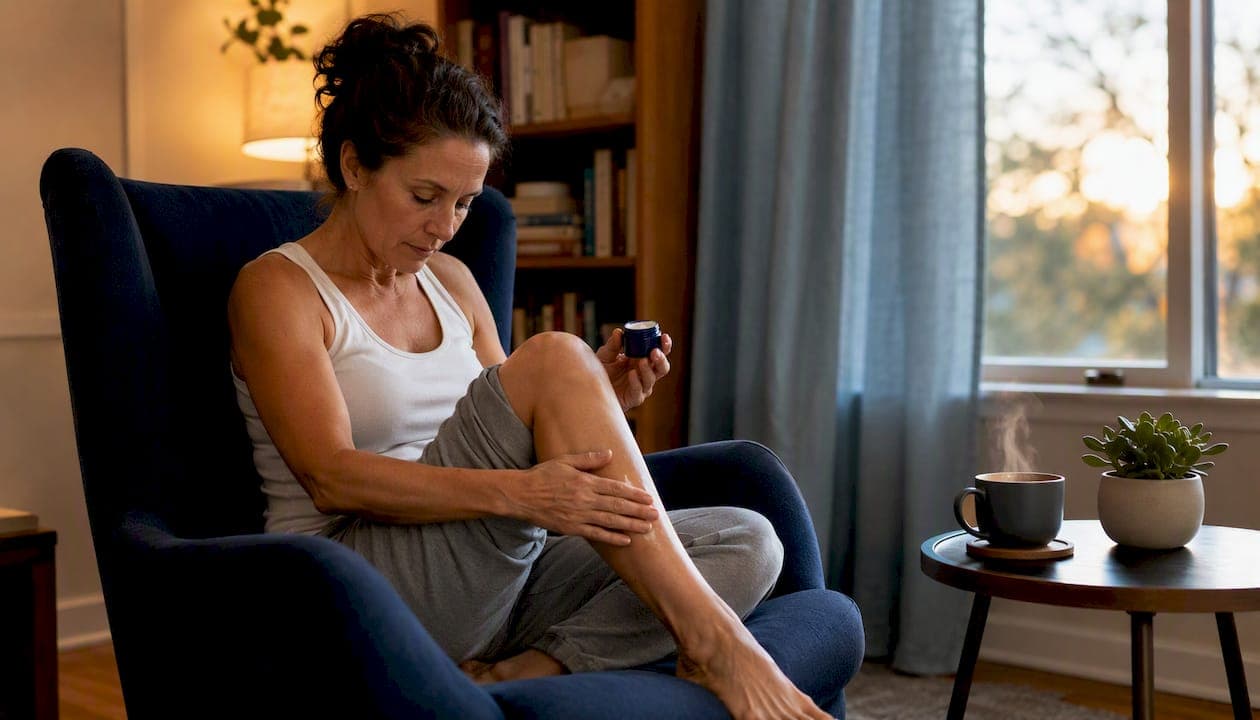
Topical CBD balms can provide real, localized relief for leg soreness and some of the uncomfortable sensations associated with restless legs, but they are not a proven cure for Restless Legs Syndrome as a neurological disorder. That distinction matters for anyone reaching for a balm at 2 AM.
Here is what the evidence actually supports:
- A 2026 exploratory open-label trial found that daily 2.7 mg THC/2.5 mg CBD produced significant IRLS score improvements at 1 and 3 months (p < 0.001), with sustained benefit in patients who stayed on therapy. The design was open-label and the sample was small, so treat this as a promising signal, not a verdict.
- A 2023 pilot study in former elite athletes with chronic lower-extremity pain showed mean self-reported pain dropping significantly over six weeks of topical CBD use, with mostly minor skin reactions that resolved on their own.
- The FDA advises against CBD during pregnancy or breastfeeding. Always patch test before full application.
Topical CBD works best as a targeted, non-systemic tool. It can quiet localized aching, reduce perceived soreness, and deliver a cooling or warming sensation that interrupts the discomfort cycle. What it cannot do reliably is address the central neurological drivers of true RLS.
Table of Contents
- Is your leg discomfort actually RLS, or something else?
- What does the research actually show about CBD and leg pain?
- How topical CBD works on sore legs
- Safety, pregnancy warnings, and U.S. legal status
- How to choose a CBD balm for leg discomfort
- How to apply a CBD balm for leg soreness or RLS discomfort
- When a topical is not enough: red flags to take seriously
- Key Takeaways
- The case for realistic expectations with topical CBD
- Mongoosecbd balms worth trying for leg discomfort
- Selected sources and further reading
Is your leg discomfort actually RLS, or something else?
This question shapes everything about how useful a topical balm will be for you.
Restless Legs Syndrome is a neurological sensorimotor disorder. The hallmark is an irresistible urge to move the legs, typically worse at rest and at night, often accompanied by creeping, crawling, or aching sensations that ease with movement. It has diagnostic criteria, dopaminergic and iron-metabolism underpinnings, and in moderate-to-severe cases it usually requires medical management.
Muscle cramps are something different entirely. A cramp is a sudden, involuntary contraction, often triggered by dehydration, electrolyte imbalance, or overuse. Delayed-onset muscle soreness (DOMS) is the familiar post-workout ache that peaks 24–48 hours after exercise. Both respond well to hydration, stretching, electrolytes, and topical treatments.
Where does a CBD balm fit? Consider two scenarios. A runner with tight, aching calves after a long training run is dealing with localized muscle soreness. A topical balm with CBD, menthol, and arnica can plausibly reduce that aching and speed perceived recovery. A person with true RLS experiencing nocturnal creeping sensations driven by central dopaminergic dysfunction is dealing with something a skin-level product cannot fully reach. The balm may still help the peripheral discomfort component, but it will not stop involuntary periodic limb movements or address the underlying neurological mechanism.
Knowing which category you are in sets realistic expectations before you spend a dollar.
What does the research actually show about CBD and leg pain?
The evidence is genuinely mixed, and being honest about that is more useful than overselling it.
The strongest signal for RLS specifically comes from the 2026 PubMed exploratory trial mentioned above. Daily THC/CBD combination therapy produced statistically significant IRLS improvements, and many patients maintained that benefit at one year. The catch: open-label design, no placebo arm, small sample. These are hypothesis-generating results, not practice-changing ones.
On the other side, a post-hoc analysis of a phase II/III trial in Parkinson's patients with RLS found that CBD doses of 75–300 mg showed no difference from placebo for RLS outcomes in that subgroup. Different population, different delivery route, but a real null finding that belongs in any honest summary.
For topical use specifically, the 2023 Journal of Cannabis Research pilot is the most relevant data point. Pain scores dropped from 3.5 to 1.7 over six weeks, and 70% completed the protocol. Adverse effects were minor and self-resolving. A registered clinical trial (NCT07224932) is now evaluating the tolerability and efficacy of high-CBD extract specifically for idiopathic RLS, which signals growing research interest.
| Study | Design | Population | Key Finding |
|---|---|---|---|
| 2026 PubMed RLS trial | Open-label exploratory | RLS patients | IRLS improved significantly at 1 and 3 months (p < 0.001) |
| 2023 Springer topical pilot | Open-label pilot | Former elite athletes, chronic leg pain | Pain 3.5 → 1.7 over 6 weeks; 70% completion |
| Liebertpub phase II/III post-hoc | Post-hoc subgroup | Parkinson's with RLS | CBD 75–300 mg: no difference vs placebo |
| NCT07224932 (ongoing) | Randomized, placebo-controlled | Idiopathic RLS | Safety and tolerability under evaluation |
Bottom line: topical CBD has a reasonable evidence base for localized chronic leg pain. For RLS as a neurological condition, the picture is promising but preliminary.
How topical CBD works on sore legs
Topical CBD interacts with endocannabinoid system (ECS) receptors in the skin and peripheral nociceptors, modulating local pain signals and reducing localized inflammation without meaningful systemic absorption. That last part is the key tradeoff: you get targeted action at the site of application, not a body-wide effect.
Several ingredients in a well-formulated balm each pull their own weight:
- CBD: Modulates peripheral ECS receptors and may reduce local inflammatory signaling.
- Menthol: Activates TRPM8 cold receptors, producing immediate cooling that interrupts pain perception.
- Arnica: A botanical with anti-inflammatory properties commonly used in sports recovery.
- Cayenne/capsaicin: Activates TRPV1 receptors, initially producing warmth and then desensitizing local pain fibers with repeated use.
- Essential oils (eucalyptus, peppermint, lavender): Enhance skin penetration, add sensory relief, and may have mild anti-inflammatory properties.
Pro Tip: Expect the cooling or warming sensation within minutes. For consistent reduction in chronic soreness, give a topical at least one to two weeks of daily use before evaluating whether it is working. Oral CBD reaches the bloodstream; a balm does not, so comparing the two is like comparing a heating pad to a fever reducer.
Safety, pregnancy warnings, and U.S. legal status
The single most important safety rule: the FDA explicitly advises against using CBD products during pregnancy or breastfeeding due to potential risks to the developing fetus and infant. No topical benefit outweighs that risk.
Beyond pregnancy, the 2023 topical pilot reported that the most common adverse effects were skin dryness and rash, both minor and self-resolving in most participants. Anyone with sensitive skin or a history of contact dermatitis should patch test before applying to a large area.
On drug testing: Hemp-derived CBD topicals are formulated to contain no detectable THC, but formulations vary. If you are subject to workplace drug testing, verify the product's Certificate of Analysis (COA) for THC content at the batch level. Trace THC in a poorly labeled product can accumulate with repeated use.
Federally, hemp-derived CBD topicals with less than 0.3% THC are legal under the 2018 Farm Bill. State laws vary, so check your state's current rules if you are uncertain. For topicals specifically, the practical risk is low since systemic absorption is minimal, but label accuracy still matters.
How to choose a CBD balm for leg discomfort
Not all balms are equal. Here is what to look for before buying:
| Feature | What to look for | Why it matters |
|---|---|---|
| CBD potency | 1,000 mg per ounce or higher | Higher concentration reaches peripheral receptors more effectively |
| Spectrum | Broad-spectrum or isolate for THC-free; full-spectrum for entourage effect | Isolate avoids THC; full-spectrum may offer broader cannabinoid synergy |
| Active botanicals | Menthol, arnica, capsaicin, or essential oils | Each adds a distinct pain-modulating mechanism |
| COA availability | Third-party, batch-specific, recent | Confirms actual CBD content and THC levels |
| Allergens/vehicle | Check for plant oils, beeswax, fragrance | Relevant for sensitive skin or known allergies |
Full-spectrum balms may offer what researchers call an entourage effect, where multiple cannabinoids work together, but they can contain trace THC. Broad-spectrum and isolate products avoid that, though some users find them slightly milder. Scent and carrier oils also affect how well a balm penetrates and how long it stays comfortable on skin.
Pro Tip: Always request or download the COA for the specific batch you are buying, not just a generic lab report from the brand's website. Match the batch number on the packaging to the COA. If a brand does not publish batch-level COAs, that is a reason to look elsewhere. Starting with a sample size before committing to a full tin is a smart way to test tolerance.
How to apply a CBD balm for leg soreness or RLS discomfort
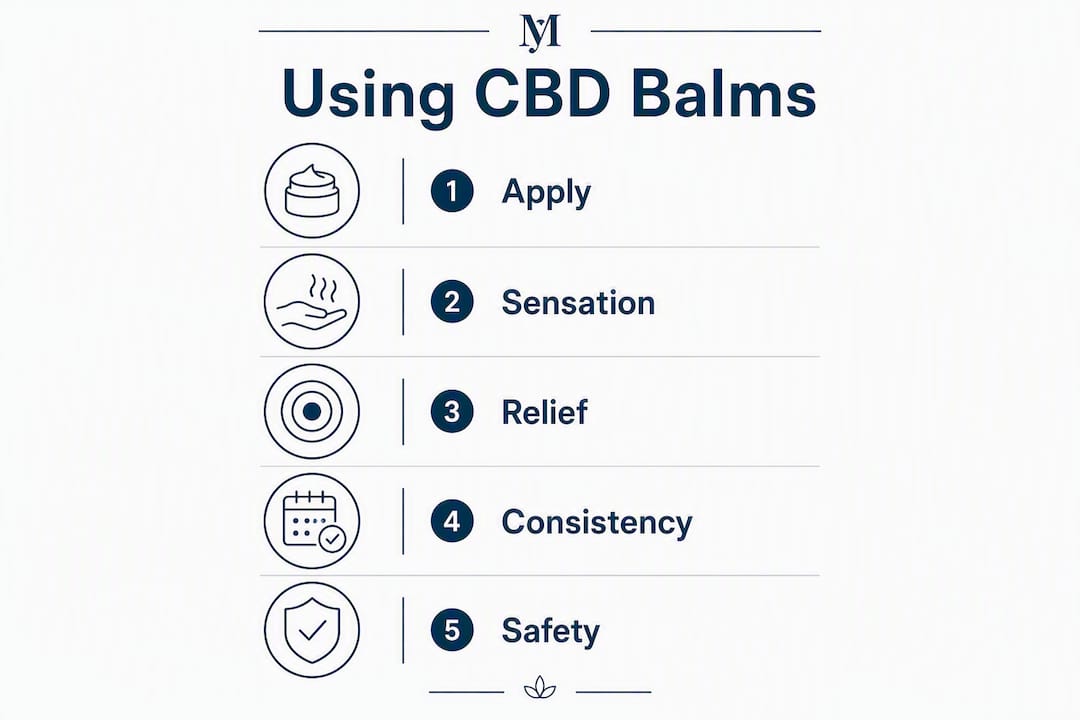
- Patch test first. Apply a small amount to the inside of your wrist or elbow. Wait 24 hours. If no redness, itching, or irritation develops, proceed.
- Clean and dry the target area. Residual sweat or lotion reduces absorption.
- Apply a dime-sized amount to the affected area (calf, thigh, or foot).
- Massage gently in circular motions for 30–60 seconds until absorbed.
- Repeat 1–3 times daily or as directed on the label.
- Evaluate over time. Cooling or warming sensation arrives within minutes. For chronic soreness, assess consistently over one to two weeks. For RLS-related discomfort, note whether the peripheral aching component eases, even if involuntary movements persist.
Combine topical application with stretching, adequate hydration, and magnesium supplementation if cramps are part of your picture. These are complementary, not competing, approaches. Stop use and consult a clinician if you experience intense skin reaction, worsening symptoms, or any sign of systemic reaction.
When a topical is not enough: red flags to take seriously
A CBD balm is self-care, not a substitute for medical evaluation. Seek a clinician if you notice:
Progressive nightly involuntary limb movements that disrupt sleep, sudden onset of severe leg symptoms in an older adult, signs of peripheral neuropathy (numbness, tingling, burning that spreads), or leg symptoms accompanied by swelling, redness, or warmth that suggest vascular involvement. Worsening sleep loss tied to leg symptoms also warrants evaluation, not just a new product.
For suspected RLS, a primary care visit is the right first step. Ask for iron studies, specifically ferritin, since iron deficiency is a well-established driver of RLS that a topical cannot address. Neurology or sleep medicine referral is appropriate when symptoms are frequent, severe, or not responding to conservative measures. Tell your clinician you are using a CBD topical. It is relevant context, and most clinicians will appreciate the transparency.
Key Takeaways
Topical CBD balms are a reasonable, evidence-supported option for localized leg soreness and peripheral RLS discomfort, but they work at the skin level and cannot replace medical care for true neurological RLS.
| Point | Details |
|---|---|
| Topicals target local symptoms | CBD balms modulate peripheral pain receptors and reduce localized soreness; they do not address central RLS mechanisms. |
| Clinical evidence is promising but mixed | The 2026 RLS trial showed significant IRLS improvement; a phase II/III post-hoc found no clear CBD benefit vs placebo in a Parkinson's subgroup. |
| Choose products with COAs and high potency | Look for high CBD concentration, a batch-specific third-party COA, and active botanicals like menthol or arnica. |
| Avoid CBD during pregnancy | FDA guidance is clear: CBD use during pregnancy or breastfeeding carries potential risks and should be avoided. |
| Mongoosecbd for high-potency topicals | Mongoosecbd's Seriously Soothing Pain Balm and Miracle Pain Balm deliver 1,000 mg/oz with botanicals and batch COAs. |
The case for realistic expectations with topical CBD
There is a version of the CBD conversation that oversells everything and a version that dismisses everything. Neither is useful.
What the evidence actually supports is narrower and more interesting: topical CBD, at sufficient concentration and with the right co-ingredients, can meaningfully reduce the peripheral discomfort component of leg pain. For athletes, that means faster perceived recovery and less post-training soreness. For someone with RLS, it may quiet the aching and crawling sensations enough to make the night more manageable, even if it does not stop the underlying neurological process.
The mistake most people make is expecting a balm to work like a pill. It does not reach the bloodstream in meaningful amounts. That is a feature for athletes who want localized action without systemic exposure, and a limitation for anyone hoping to address a central neurological condition through the skin. Knowing which situation you are in before you apply is what separates a useful tool from a disappointment.
The 2023 topical pilot data showed pain scores dropping from 3.5 to 1.7 in former elite athletes over six weeks, with 70% of participants completing the protocol. But those were people with chronic localized pain, not a randomized controlled trial for RLS. Holding both truths at once, that topical CBD works well for what it can reach and not at all for what it cannot, is the most honest and useful frame for anyone deciding whether to try it.
Mongoosecbd balms worth trying for leg discomfort
If you have read this far and want a topical that actually delivers on potency and ingredient quality, Mongoosecbd has built its line specifically for this use case.
The Seriously Soothing Pain Balm comes in Original, Eucalyptus Mint, and Lavender Lemongrass, all formulated at 1,000 mg CBD per ounce with menthol, arnica, and botanical actives. The Miracle Pain Balm is the higher-intensity option, built for chronic pain sufferers who need more than a light recovery product. All products are THC-free, vegan, non-GMO, paraben-free, and cruelty-free. Batch COAs are available on product pages. Review them before purchasing.
Not sure which to start with? A Miracle Pain Balm sample lets you patch test and evaluate before committing to a full tin. Every purchase is backed by a 30-day full refund policy. Browse the full line at the Mongoosecbd shop and pick the formulation that fits your symptoms.
Selected sources and further reading
- Tetrahydrocannabinol/cannabidiol in the treatment of restless legs syndrome (PubMed, 2026)
- Topical cannabidiol is well tolerated in individuals with a history of elite physical performance and chronic lower extremity pain (Journal of Cannabis Research, 2023)
- Topical cannabidiol is well tolerated in individuals with a history of elite physical performance and chronic lower extremity pain (PMC)
- The Effect of Cannabidiol for Restless Legs Syndrome in Parkinson's Disease Patients: A Post Hoc Exploratory Analysis of Phase 2/3 Clinical Trial (Mary Ann Liebert)
- Tolerability and Efficacy of CBD Extract for RLS Treatment, NCT07224932 (ClinicalTrials.gov)
- U.S. Food and Drug Administration — CBD consumer guidance
- Mongoosecbd shop and refund policy